Overview
SAP is built for large, complex organizations: deep manufacturing, multinational finance consolidation, and regulatory requirements across many countries. That depth comes with a matching implementation footprint: dedicated consultants, months of configuration, and separate tools bolted on for chat and field capture.
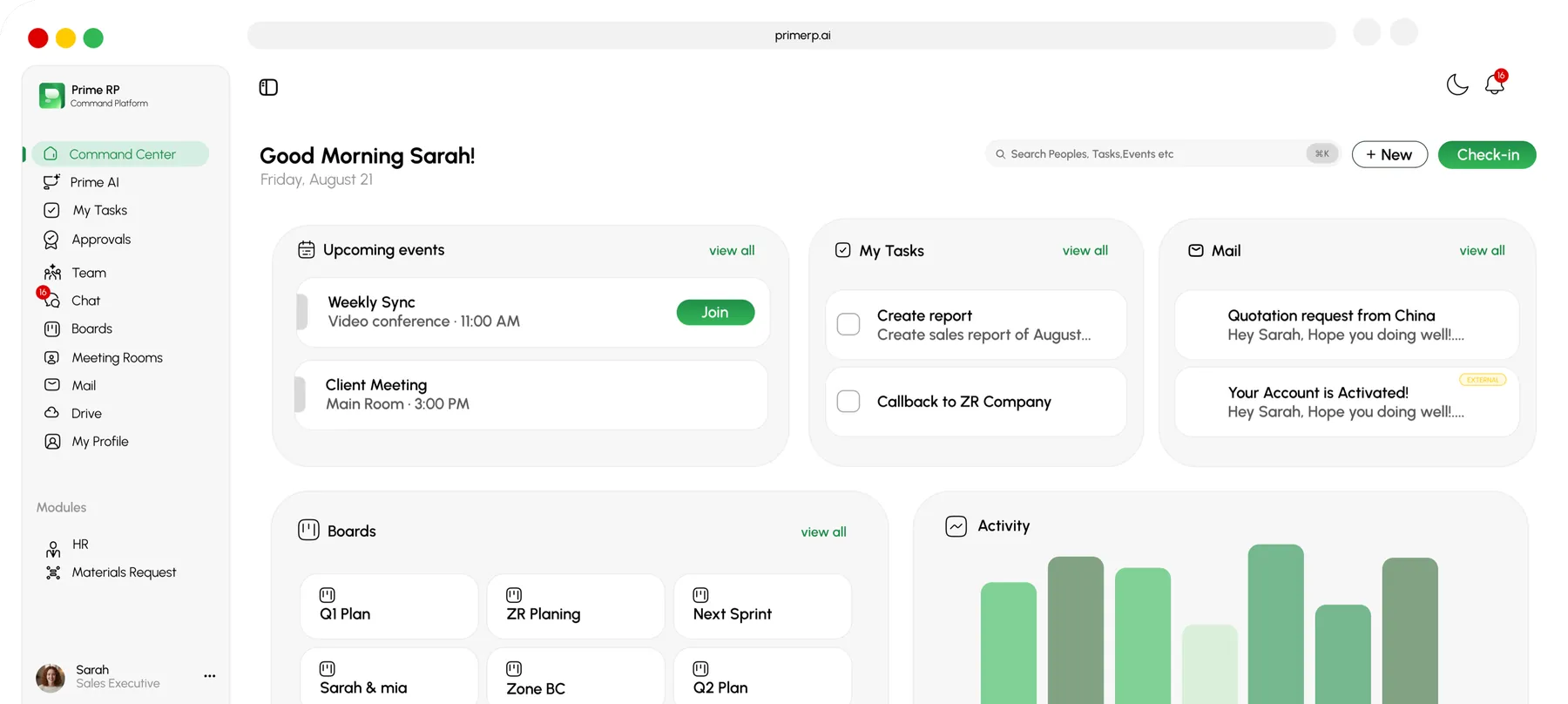
Prime RP is built for the operations layer underneath that: projects, approvals, procurement, finance, HR, and field work, with team chat and video conferencing native to the same platform, not a separate license or a Teams integration.
Where Prime RP wins
For construction, EPC, and field-operations teams, the gap shows up in three places: how work gets talked about, how progress gets measured, and how long it takes to get running.
- Chat and video are part of the platform: a message about a task, approval, or invoice lives next to the record it concerns, not in a separate app.
- Field engineers capture photo, video, and audio reports offline; submissions queue locally and sync automatically, with no separate mobile module to license.
- Project progress is computed from weighted, approved sub-projects, not a manually typed percentage that someone forgot to update.
- Role and sub-role access control ships as a core capability, not a consulting-led configuration project.
Where SAP still makes sense
SAP's strength is genuine: for multinational manufacturers with complex, multi-entity finance consolidation and deep regulatory requirements across dozens of countries, its depth and third-party ecosystem are hard to match.
If your organization is already standardized on SAP for manufacturing or global finance, replacing it isn't the right conversation. Connecting the operational layer around it usually is.
Feature-by-feature
| Capability | SAP | Prime RP |
|---|---|---|
| Chat & video built into records | Separate tool (Teams) | Native |
| Offline field reporting | Add-on module | Native |
| Weighted WBS progress | Configurable, complex | Built-in |
| Typical time to go live | 6–18 months | Weeks |
| Role + sub-role access control | Consulting-led setup | Out of the box |
Switching from SAP
Moving off SAP entirely is rarely realistic for the organizations that need it. Moving the operational layer (projects, approvals, procurement, field work, and the communication around them) is a different, much smaller project.
The Control Panel's audited bulk imports bring over clients, teams, and reference data as tracked import runs, and the open API and accounting sync keep finance connected if SAP or another accounting system stays in place for the ledger.
The verdict
SAP remains the right call for large multinational manufacturers with deep finance and regulatory complexity. For construction, EPC, and field-heavy teams that want projects, approvals, finance, and communication in one connected platform without a year-long rollout, Prime RP is built for exactly that gap.